
[Twitter, 6/5/19] Medieval Buddhists of the Day: Gao Lang 高朗 and Cao Adai 曹阿待, a husband-and-wife duo. They are known by the rather jolly donor figures that depict them on the base of the Buddhist image they sponsored in 496. She is so ample, and he so slender, that they kind of look like Jack Sprat and his wife. Of course, there’s no way to know how much these images looked like the real people they represented, but still.
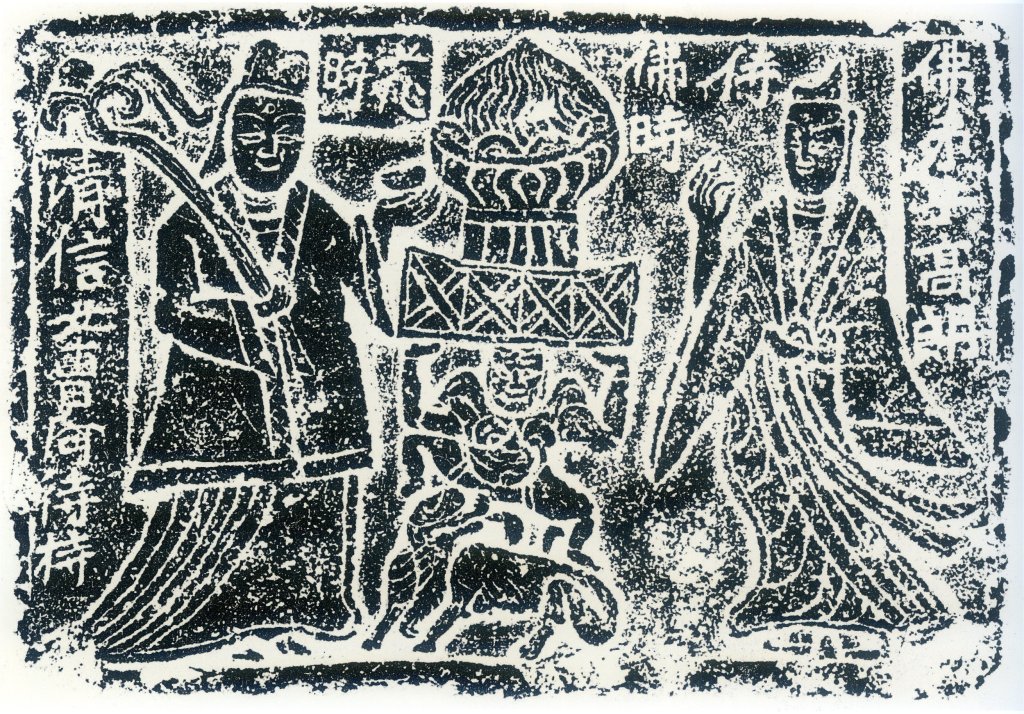
Gao is on the proper left of the image (viewer’s right) and his wife stands opposite him. Between them is an elaborate censer on a blocklike base, supported by an atlantean figure standing on what looks like a tortoise but may be meant for a lion. Early Chinese Buddhist art is full of lions sculpted by people with only the vaguest idea of what a lion looks like. Cao Adai holds an oversized flower stem over her shoulder with her right hand, while her left hand holds an object which may be some kind of offering. Gao Lang holds up his right hand with fingers together as if holding a pinch of incense to cast on the coals. The inscription actually describes their actions: 佛弟子高朗侍佛時 “when the Buddhist disciple Gao Lang made offering to the Buddha” and 清信女曹阿待持花時 “when the pure and faithful daughter Cao Adai came bearing flowers.”
That’s all fairly typical for the time. What’s interesting is their dress. Gao Lang wears a robe with flared sleeves, which wraps around his body and ties with a sash, not unlike a modern bathrobe. He has a small asymmetrical cap atop his head. Cao Adai wears a tunic-like coat with decorative borders over a full skirt, and a tall double-crowned hat with a flap hanging down behind to cover the neck. In fact, she is wearing Xianbei-style dress, whereas Gao’s garments and headdress were understood at the time as indigenous (“Chinese”) dress. Mid-sixth century images regularly show women in Chinese-style robes and men in Xianbei-style dress (with trousers instead of skirt). That later contrast is part of a process by which ethnic differences in dress become assimilated to gender [I wrote an article about this].
This image is at least 40 years too early for that. But it is contemporary with an imperial edict which prohibited the wearing of Xianbei-style dress at court, prescribing Han-style dress instead. We don’t know what rank Gao Lang held, if any, but this edict may have affected him. But the edict only applied to the imperial court, and not to what people wore in private life. One imagines that Cao Adai, having no obligation to attend court, preferred to wear Xianbei-style dress. She certainly looks comfortable, so more power to her. Finally, we don’t know if the dress shown in donor portraits was in fact what the person actually wore. But it was what they felt comfortable being depicted wearing, so must reflect some sense of the appropriate, if not necessarily the actual.
 Medieval Buddhist of the Day
Leave a comment