
[Twitter 6/10/19] Medieval Buddhist of the Day: An anonymous donor from Niche 11 in cave 169 at Binglingsi, located southwest of Lanzhou in Gansu province. These paintings date to the Western Qin, about 440 CE. The donor’s cartouche was never filled in, so we do not know her name.

Look at the rightmost of the three female figures standing to the left of the Buddha-triad. The two women behind her may be daughters or maidservants, or (I suspect) one of each. Our donor wears a short tunic-like coat with full sleeves over a skirt with vertical stripes. Some writers have called this a form of nomadic dress, but it has little in common with Xianbei-style garments we see depicted in this region and period. It has much more in common with women’s dress seen in Koguryo mural-painted tombs in Jilin and North Korea.
Here is an image from the Pyongan-nando 平安南道 tomb, dated (IIRC) to the late fifth century, so a couple of decades after our donor. Look at the woman at far right, standing under an umbrella held by a servant. It’s the same short jacket and striped skirt.

And while we’re at it, the famous women from the Takamatsuzuka tomb 高松塚古墳. This is considerably later, dating around the turn of the 8th century, and Asuka-period fashion obviously dictated a low-slung sash. But look at those skirts!
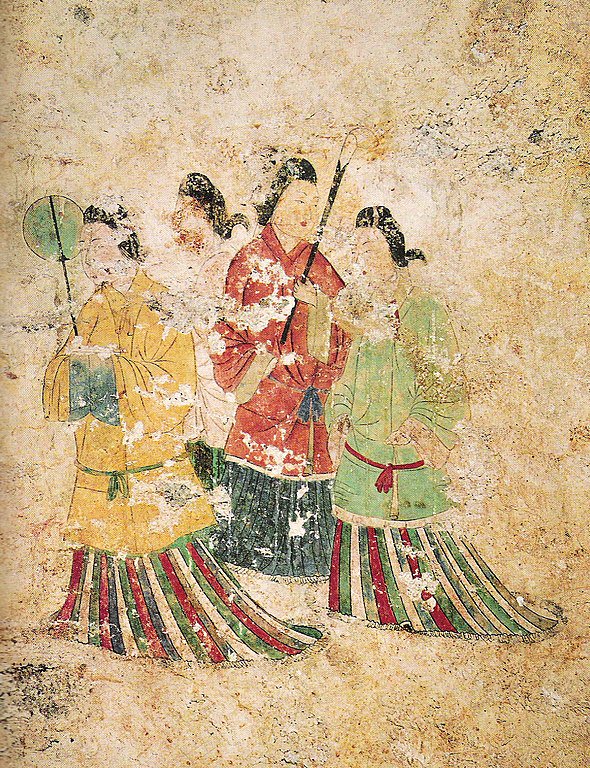
Explaining Koguryo influence on Asuka painted tombs isn’t that difficult, given proximity and shared history. But what is our donor doing sporting Koguryo fashion way out in Gansu? I can’t think of other donors from the same region in this dress, though some of the female figures in Dingjiazha tomb no. 5 丁家闸五号墓, dated to the Northern Liang, wear those striped skirts with a different top. Things and people in the fifth century really got around, so maybe we shouldn’t be surprised. But it’s still interesting.
 Medieval Buddhist of the Day
Leave a comment