
[Twitter, 6/13/19] The Medieval Buddhist of the Day is another aunt. We are on a roll with the aunts. This one is also a nun, like yesterday’s MBOTD. Her name is Dhyana-Master Jinggan 靜感禪師 and her ashes were interred in 646 in a cliff-face niche at the Lingquan Temple at Baoshan, near Anyang in northern Henan.
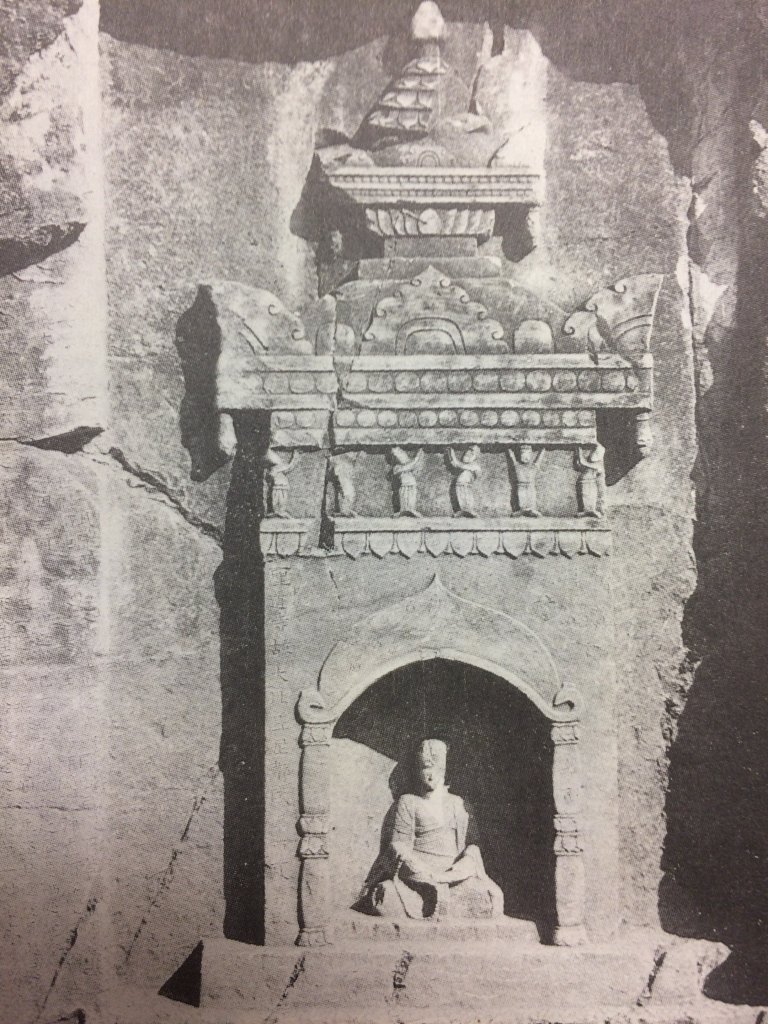
She was born to a family named Xu 徐 with roots in Dunhuang (!). Her niche comes with a long inscription about her religious career, but I’m particularly interested in the way it reflects her personal relationships.
The people responsible for her memorial were “her nieces Jingduan and Jingyin, and her disciples” 侄女靜端靜因及門徒等. Let’s take the disciples first. Most of the memorial niches at Lingquansi belong to monks, nuns, and lay believers of both genders (upasaka/upasika). Many memorials for monks and nuns were explicitly dedicated by their disciples or followers 弟子、門徒. Granted that in the secular context, a memorial was the responsibility of a son or daughter, this puts the disciples in a parent-child relationship with their teachers, and it’s likely that the relationship was analogized to a filial one, to some extent.
Jingduan and Jingyin are Jinggan’s actual nieces 侄女 (usually a brother’s daughter), but by their names, we can tell that they’re also nuns, and given the shared character Jing 靜, maybe ordained in the same community? I haven’t a clue about naming patterns for Tang nuns, but a shared name character was already in use in the 6th century (maybe earlier?) to indicate siblings or cousins of the same generation, so one suspects a connection here.
Monastic names tend to obscure kinship relations, but available evidence suggests that monastics didn’t sever relations with their families, contrary to the suggestion of the term “family-leaver” 出家人. Here’s a case where we see family members asserting their relationship within the institutional bounds of monasticism. It’s not a unique example at Lingquansi, but it’s one of the more interesting ones. If interested I highly recommend Wendi Adamek’s work on this site esp. her article “The Agency of Relations at Baoshan.”
 Medieval Buddhist of the Day
Leave a comment