
[Twitter 7/23/19] Medieval Buddhists of the Day: The female patrons from a stele dated to the Northern Zhou (557-581) by style, dedicated by 70+ patrons in a mixed-gender association (邑) that included donors with a wide range of surnames. The stele is now at the Yaowangshan 藥王山 museum. It’s not at all clear what held this group of patrons together – their dedication is extremely generic – but what’s interesting is how the female patrons are named. In most cases they aren’t recorded by personal name (as is common elsewhere), but rather by formula.
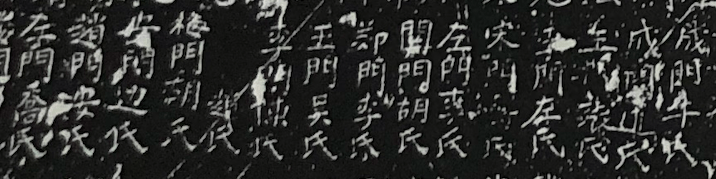
This snippet of a rubbing is blurry, but you can see that all the women are X 門 Y 氏, or “Née Y, of the X household,” X presumably being their husband’s surname. Hence 鄭門李氏, “Née Li, of the Zheng household,” or in a more modern idiom, “Madame Zheng, née Li.” I’m struck by this because it is an incredibly common formula seen on Chinese gravestones in Honolulu, including the ones in the cemetery I walk past on the way to and from work. But I’d never before this seen it in a medieval context. Chinese tombstones in Hawai’i are interesting as glimpses into 19th-century immigrant life, including the use of Suzhou numerals etc. But this is a convention I didn’t know was ancient. I’m not sure if it brings the past into the present, or the present into the past.
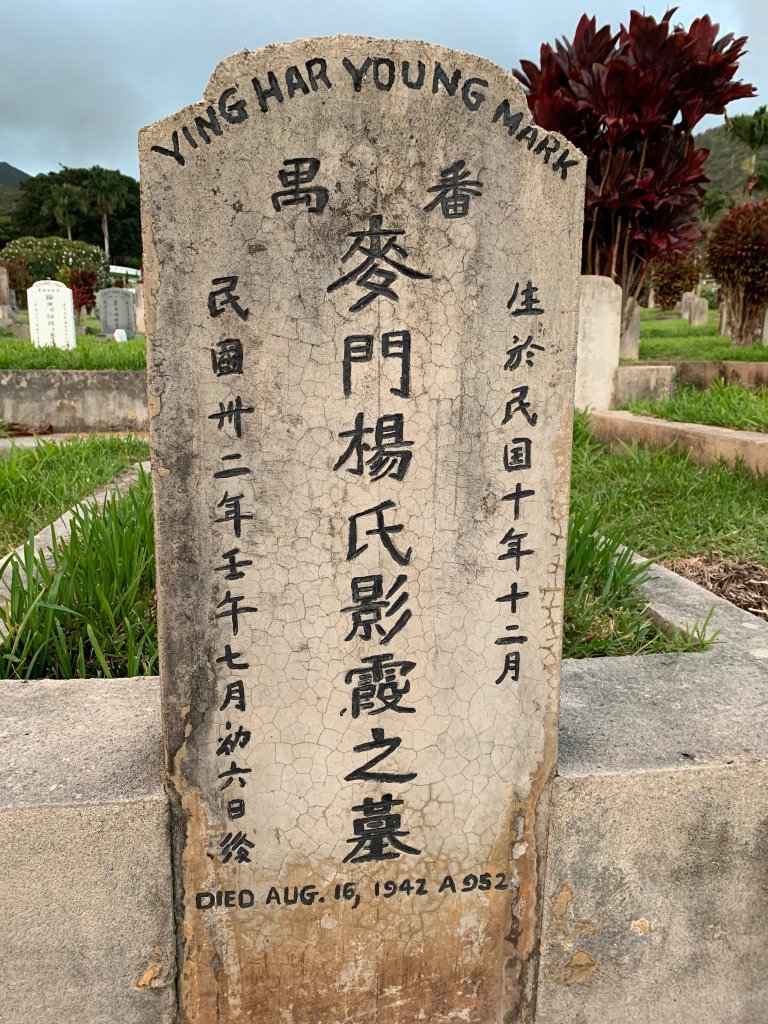
Here, for comparison, is a tombstone from 1942, from the graveyard near my house. Mrs Mark 麥, of Panyu county in Canton, was born Young Ying Har 楊影霞 and here she is named as “Mrs Mark, born into the Young family, named Ying Har” 麥門楊氏影霞.
 Medieval Buddhist of the Day
Leave a comment