
[Twitter, 4/23/20] Medieval Buddhist of the day, I’m exhausted from chairing my department during a crisis edition: This is Guo Mozi 郭摩子, the daughter of Guo Si 郭思, who with his family dedicated a Sakyamuni figure whose base is in the Freer collection (F1909.94):
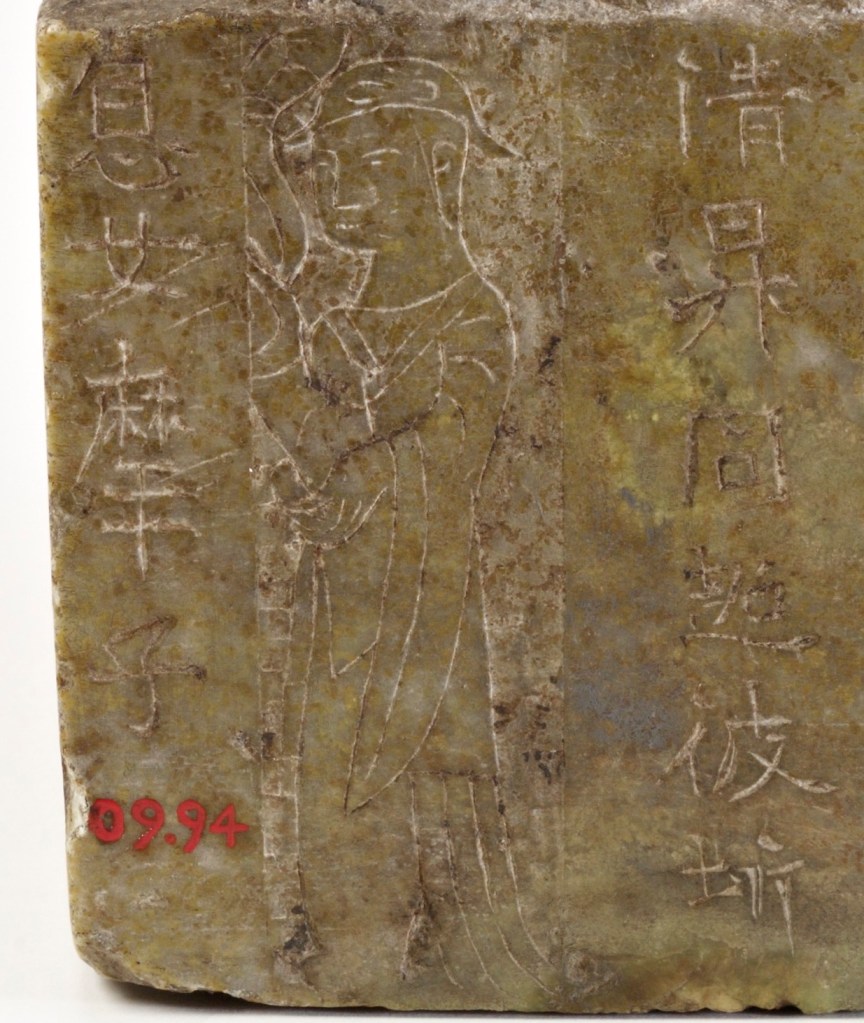
Guo Si, his wife and two daughters appear as donors on the base, which is dedicated to his two deceased sons, Guo Zhangzong 郭長宗 and Guo Zhangru 郭長儒 (rather Confucian names, come to think of it). The daughters, by contrast, are Guo Mozi and her sister, Guo Longhui 郭龍暉. If the boys’ names are somewhat Confucian, the girls’ names definitely lean Buddhist: Longhui 龍暉 seems to mean “naga-splendor,” while Mozi 摩子, well… what does it mean, actually?
The character mo 摩 on its own means to massage, to stroke, or metaphorically to mull over. But it is also conventionally used in transliterations from the Sanskrit, where it represents the syllable ma, as in Marici 摩利支, samadhi 三摩地 (more usually 三昧, but the other is attested), Mahakasyapa 摩訶迦葉, Kumarajiva 鳩摩羅什 etc. It’s so commonly used that a search through Hucker’s dictionary of Buddhist terms gives 774 results. I don’t know that there’s any way to figure out which one is being alluded to here, but I wish I could work it out. I’m tempted to see it as a transliteration of matr, mother, cf. saptamatr 七摩怛里, but my gut sense is that’s too technical for an everyday lay Buddhist. There’s always good old Vimalakirti 維摩詰, but he’s not really a female role model. I may have to keep poking around on this one, but it’s interesting to think about.
 Medieval Buddhist of the Day
Leave a comment