
[Twitter, 9/18/19] Medieval Buddhists of the Day: Jia Zikuan 賈子寬 and family. Jia dedicated a standing Guanyin image in 600, during the Sui dynasty. It’s now in the Eisei Bunko in Tokyo. Here’s what it looks like (photo after Jin Shen):
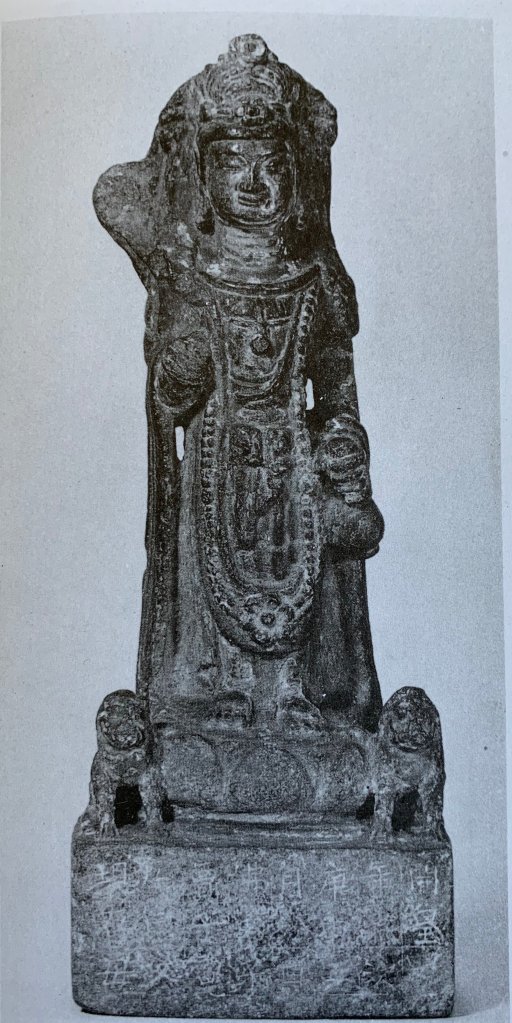
The inscription reads 佛弟子賈子寬為亡父、現存母敬造玉像一軀… “The Buddhist disciple Jia Zikuan sponsored a marble image for his deceased father and his living mother…” So far so conventional, and he goes on to express various conventional wishes for his parents in this and seven previous incarnations.
Following is a list of family members: 父仲偘、母王醜仁、亡弟世乾、弟石遷、亡妹延[ ]、亡妹相暉、女端[ ][ ]、妻周[ ]娘、亡妹舍那、亡妹金蓮。”My father (Jia) Zhongkan, my mother Wang Chouren, my late younger brother (Jia) Shiqian, my younger brother (Jia) Shiqian [different characters so not the same brother], my late younger sister (Jia) Yan[ ], my late younger sister (Jia) Xianghui, my daughter Duan [ ][ ], my wife Zhou [ ]niang, my late younger sister (Jia) Shena, and my late younger sister (Jia) Jinlian.” It’s not unusual for family members to join a dedication which is led by a single family member (often an eldest son, as here). But here we have eleven family members, counting Jia Zikuan himself, of whom six are dead.
The dedication is for the benefit of the late father and the living mother, and for parents in seven previous generations, so presumably all the other children are there as fellow donors. All seven are listed though only two are living. A principle of ancestor worship in traditional China is that kinship ties and filial duties do not end with death: even though your father has died, that doesn’t mean you can stop feeding him, and your own death doesn’t exempt you from your duties to your ancestors either. Here I imagine Jia Zikuan is seeing his dedication as an act of filial piety on the part of all his parents’ children, and the fact that five of them have already passed on doesn’t at all invalidate their ability to be his co-sponsors of this image. I can’t help wondering if the same religious merit that Jia Zikuan and his living brother were understood to gain by sponsoring the image would also be “credited” to the deceased siblings, and if so, what the effect on them might have been thought to be.
 Medieval Buddhist of the Day
Leave a comment