
[Twitter, 2/19/20] Medieval Buddhists of the Day (again): the Ning family donors from the AIC stele of 551 (see previous post). With over 800 donors, they can be the MBOD twice. So the Ning family stele has long lists of donors without any portraits. Most of the donor figures represent “special donors” who splashed out for one or more of the images on the stele, or for part of the dedication ceremony. Plenty of these are depicted as standard single figures:
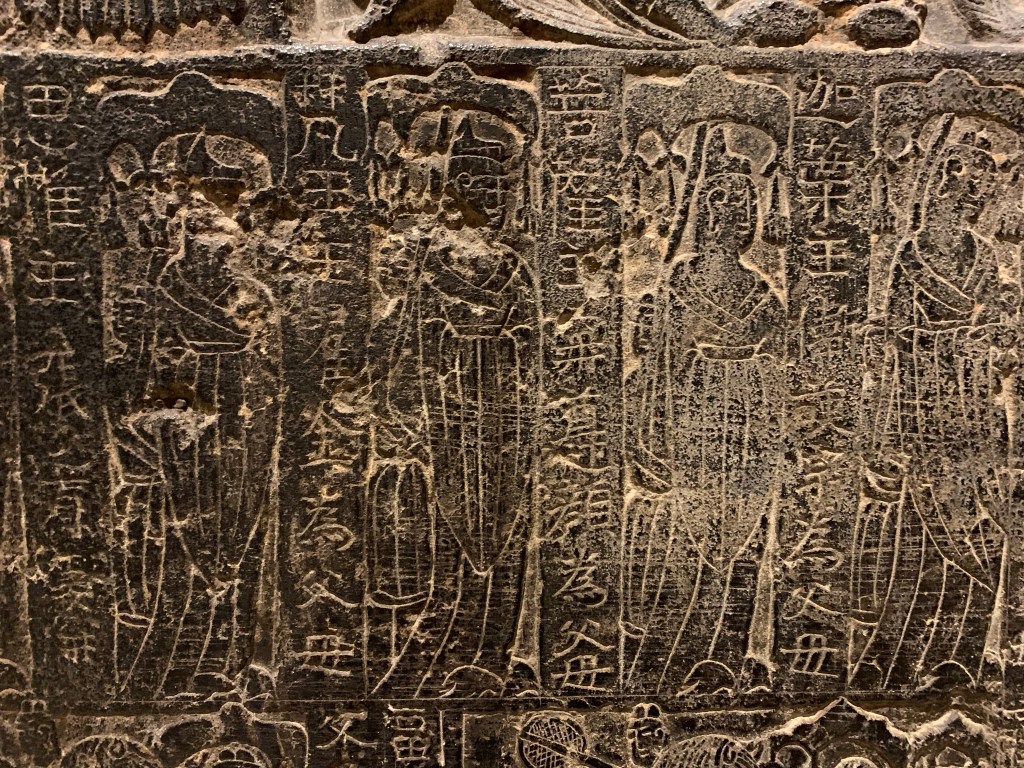
Here, from R-L, are a donor surnamed Wei 衛 who sponsored the image of Mahakasyapa, a donor named Ning 寧 who sponsored the bodhisattva next to that, a donor named Wang 王 who sponsored the devaraja, and a donor named Zhang 張 who sponsored the “pensive prince” figure. Pretty standard male figures, each accompanied by a servant holding a canopy. The fact that they’re not all Nings suggests that while the Ning clan provided the majority of the donors, the leadership was drawn from many important or allied families, and not just the Nings. The dedication inscription bears this out by describing the donors as: 篤信諸寧合宗,并諸鄉秀士,安道倍。。。他人 “the sincerely faithful and numerous members of the Ning lineage; also the refined gentlemen of various towns [nearby?], serene monks/nuns…other people”
Some donors got a little figural group, with a kneeling donor, maybe a monastic advisor, a groom leading the donor’s horse, servants, & oxcart representing the donor’s wife, modestly concealed. This is Ning Xiao 寧孝, who gave the vegetarian feast, and the monk Fahe 法和:
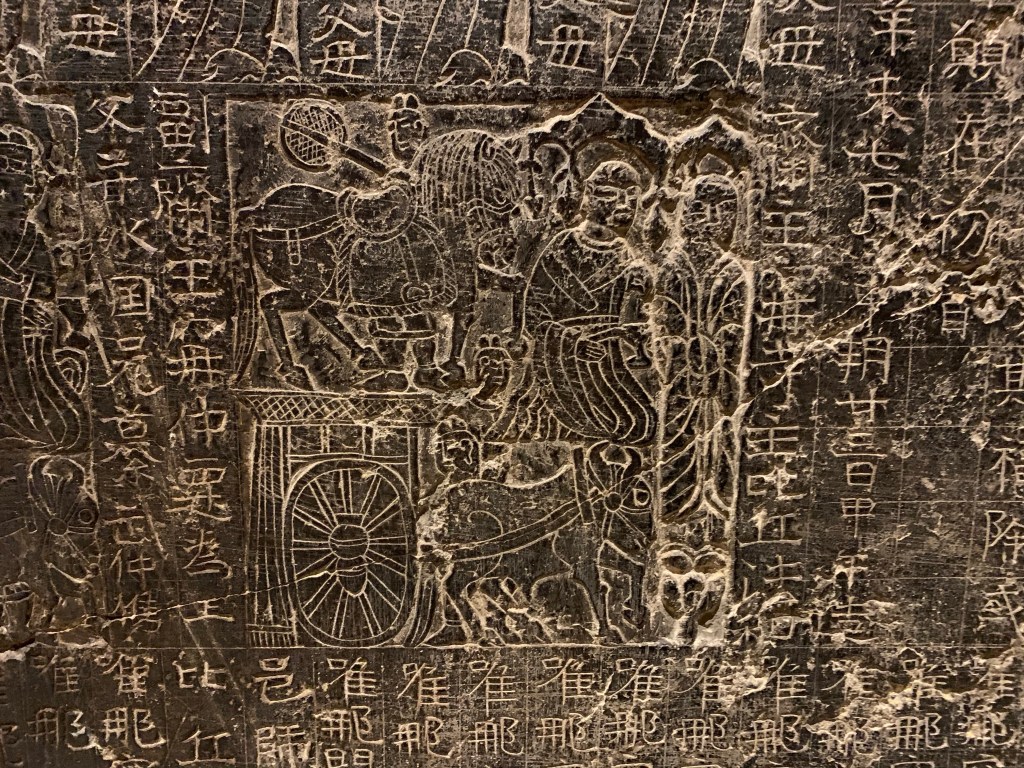
Like many such stelae, this one separates male and female patrons – male on the obverse, and female on the reverse. But there were “special patrons” for each of the many image-niches on both sides of the stele, and so there are female donor figures in positions of prominence. Here’s a female patron with a similar grouping, but it reads quite differently for her. She stands at right with two female servants. Behind her is the oxcart, which presumably belongs to her, and its groom. The horse here is not riderless. Who is the figure on its back?
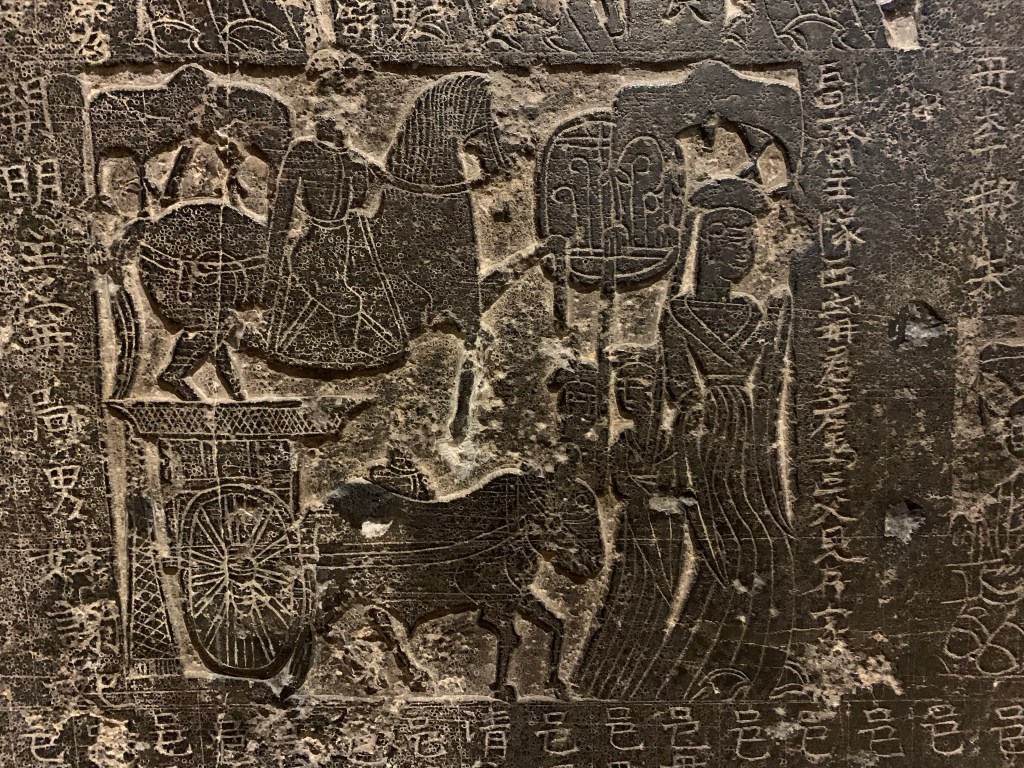
It wears what’s likely male dress, but as much as I want this to be her husband, it probably isn’t, since on this stele only male servants wear the tunic and trousers you see here. Yet if this is only an outrider, why does he have a servant holding a canopy over him? Another group opposite is a bit clearer. The previous figure was the assistant giver of the feast 副齋主 and here is the main giver of the feast 齋主, the nun Minglian 明練, who gives in honor of her mother, surnamed Li 李. The lay donor figure has no other inscription so perhaps this is Lady Li.

The two groom figures have undamaged heads here and they seem to have that double-bun hairstyle you see on youthful servants, so my best guess is young male servants; in which case the canopy at far right may be for the whole entourage? Tricky, but not impossible. The individual female donors get a bit interesting too. In general this stele gives the impression of being carved to order, rather than being provided with generic figures in advance to which donors’ names could be added. Why does this matter? Because there are places where the general symmetry of the carvings is interrupted for what seem to be reasons of personalization. We just looked at the paired 齋主 and 副齋主, the former a nun and the latter a laywoman, such that the images couldn’t be simply mirrored.
Look at this: R-L we have the sponsor of the Mahakasyapa figure, the sponsor of the main Buddha, the sponsor of the niche itself, and the sponsor of the Ananda figure. All women. But look at the figure second from the left, dressed just like the male servant behind him/her:
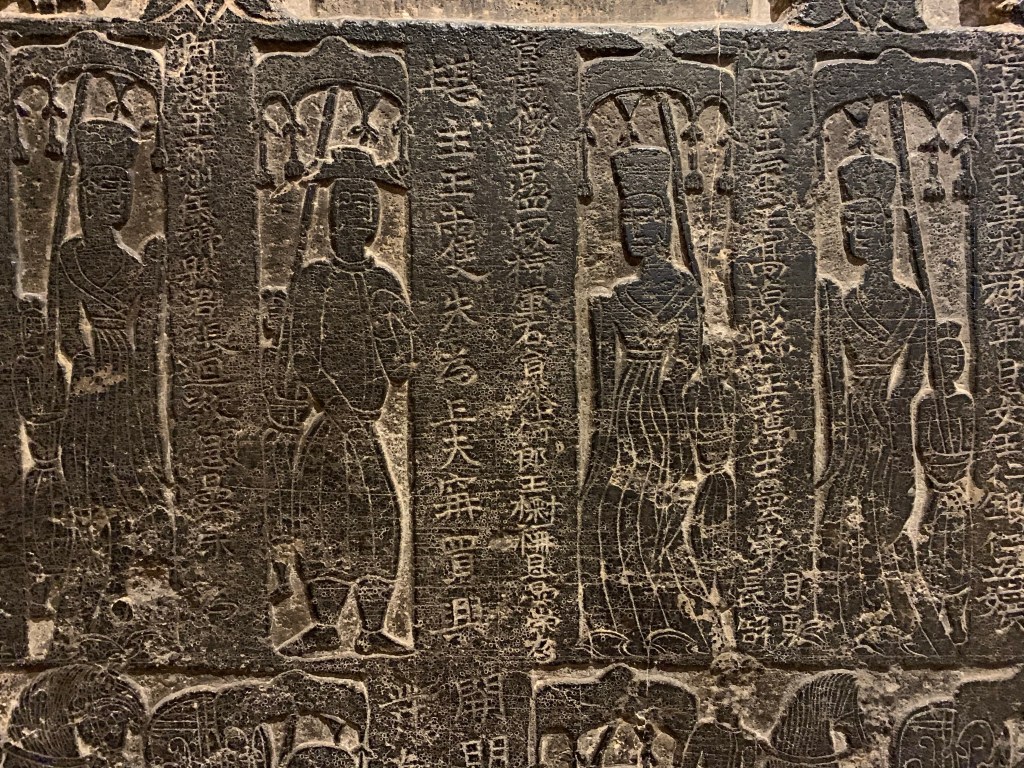
The inscription identifies the patron as Wang Huozhu? [I’m guessing at the second character “huo”] 王霍朱 who donated in honor of her deceased husband Ning Maixing 寧買興. So who is the figure, in male servant’s dress with a kind of headdress nobody else seems to have? I want it to be Wang herself, as a real-life Mulan. Southern writers kvetched about the independence of women of the Northern Dynasties; and women, especially young women, wearing just this kind of men’s dress became common in the early Tang. However, it must be conceded that donor figures can represent the person in whose honor the donation is made, rather than the donor him/herself. So it could be Ning Maixing, but in that case why isn’t he in a robe like the rest of the men? It’s perplexing, and thereby tantalizing, even as we try to resist wishful thinking. Still, I’m imagining Wang as a resourceful, no-nonsense widow, stumping around in practical clothes getting things done and refusing to be portrayed in a dress even in this formal context. 800 donors, and she’s my favorite.
[Twitter, 2/20/20] OK, can’t stop thinking about this donor figure. The more I think about it, the more I am sure it’s a cross-dressing woman. The main reason is the extra-long sleeves, which cover her hands. These make it unlikely for the dress to read as servant’s garb. In fact they remind me very much of the young girl among the palace ladies in Prince Li Xian’s tomb of 706 CE. She’s dressed in men’s (boys’) clothing as many young women were, but with extended sleeves covering her hands:
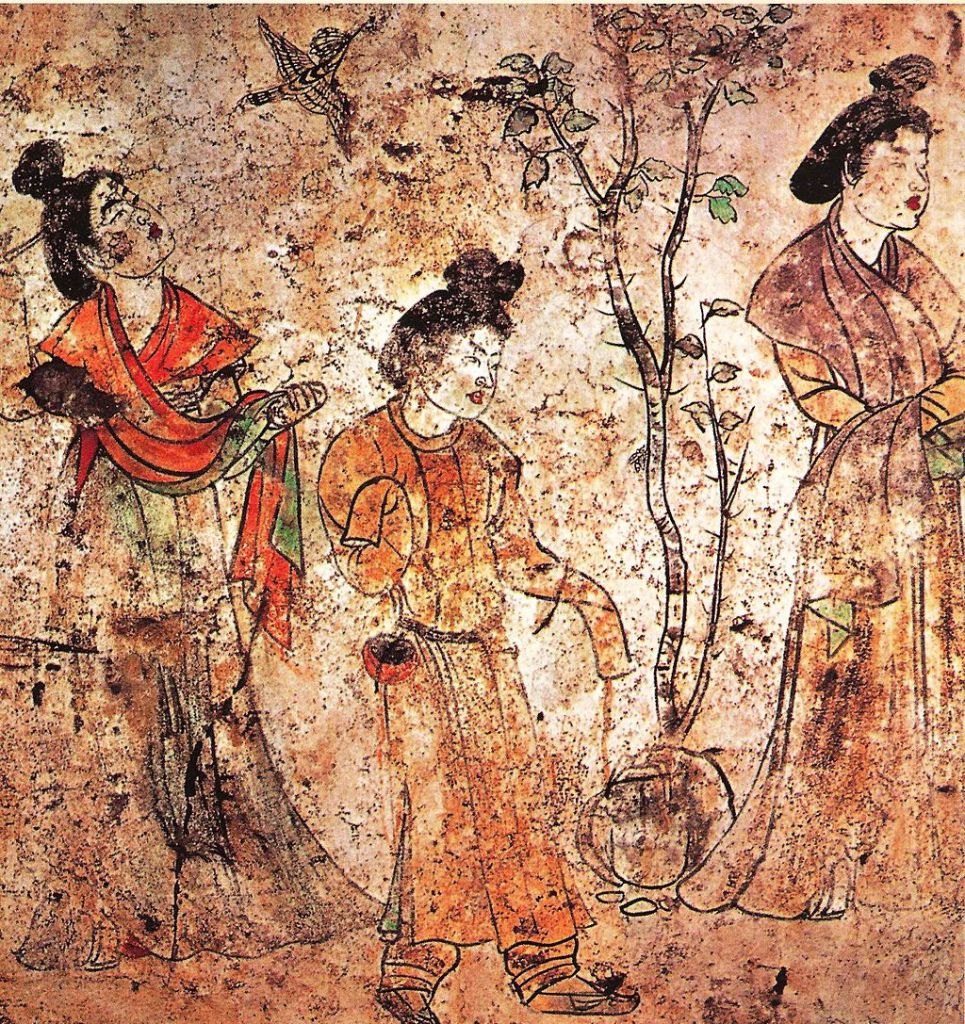
That’s precisely what Wang Huozhu is wearing, despite the fact that the AIC monument is 155 years earlier than the tomb, and that I would have said the practice of women dressing like men in this particular way didn’t get started until the Tang. Was she ahead of her time? Or was she merely interested in more practical clothing than most of the women on this monument are displayed wearing? We may never be sure, but she’s still my favorite. Meanwhile, does anybody have any idea what to make of her hat?
 Medieval Buddhist of the Day
Leave a comment