
I’m a member of a group of chamber singers, and we had a concert in December at a little Episcopal church in town that was new to me. It has these very striking memorial windows in the chancel, and I asked the priest about them, but he didn’t know where they came from.
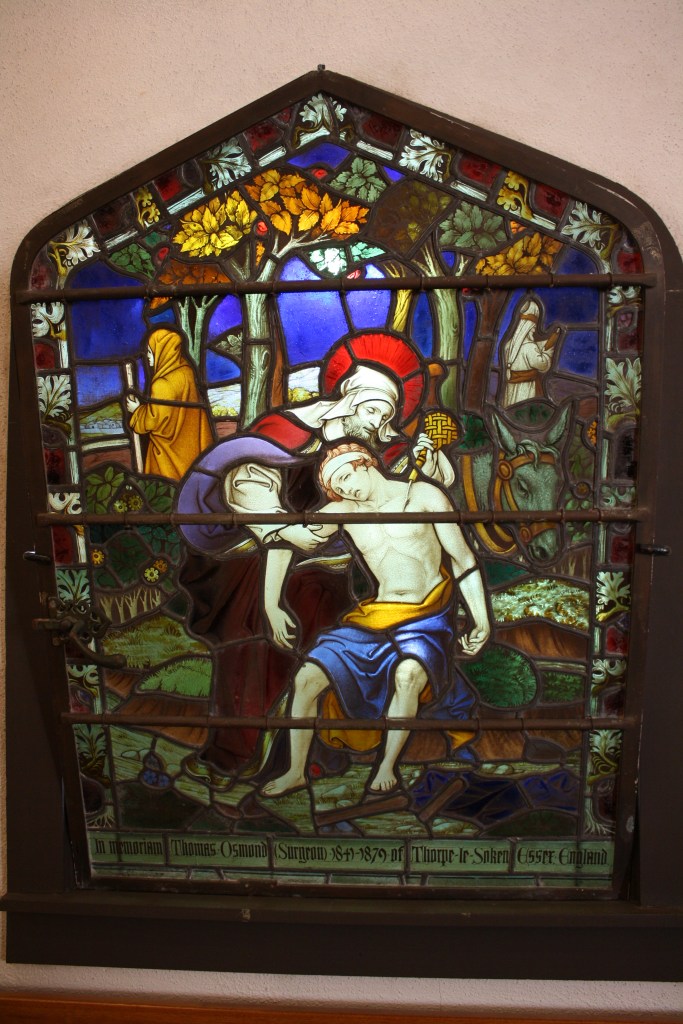
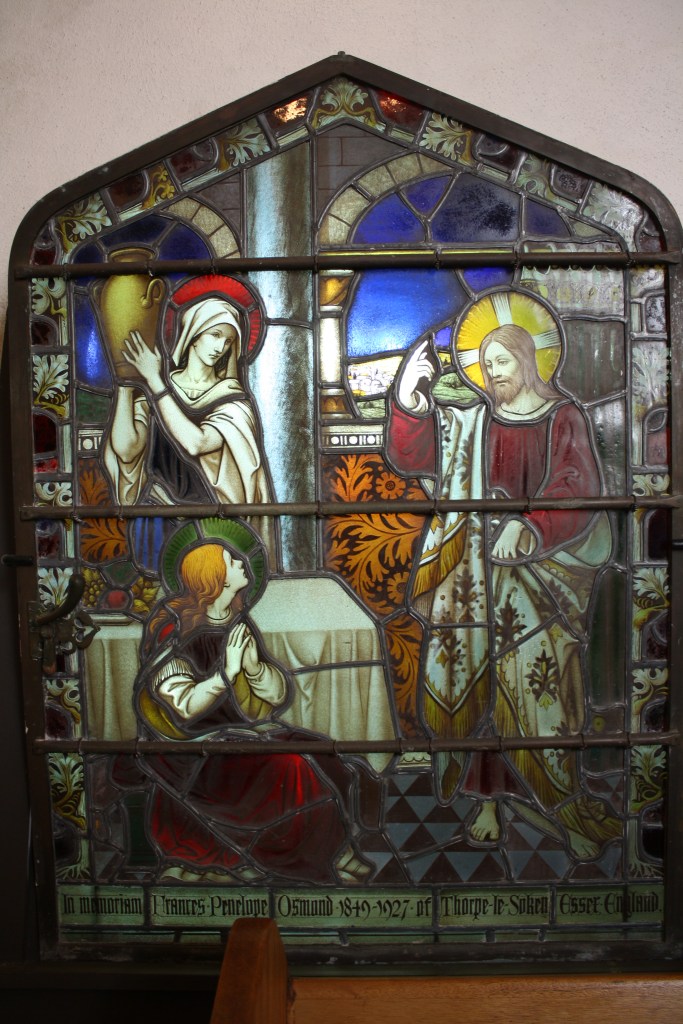
I (and he) assumed they had been bought and moved here from some other church, perhaps in England given they are dedicated to the memory of a surgeon and his wife from the Essex village of Thorpe-le-Soken. It wouldn’t have been uncommon in the early decades of the 20th century, when well-to-do Americans were buying art and architecture in Europe and shipping it back home.
Having, as you might say, some professional expertise in the matter, I offered to see if I could find out where they’d come from. The solution turned out to be far simpler than I’d imagined, and all my questions were answered by our subscription to Ancestry.com and Newspapers.com, which we have thanks to my husband’s current biography project.
The short version is that the Osmonds had two daughters, and one of them came to Hawai’i as a trained nurse in 1896, met and married the local-born son of English immigrants (the beautifully named Albion Fisher Clark), and became a prop and stay of the church community. Frances Osmond (who outlived her husband by 48 years’ presumably chaste widowhood) lived with her daughter and son-in-law in Honolulu for twenty years from about 1900 to about 1920, then returned home to England to spend her last years with her other daughter. She was also an active member of this church. Mrs Clark (née Osmond) appears to have commissioned the windows on the occasion of her mother’s death in 1927. They were made in England, shipped to Hawai’i, and installed a year later, as reported by the Honolulu Star-Bulletin on September 29, 1928.
I sent all this to the priest at Epiphany Episcopal (as it now is), including a bunch of related information about Albion Clark, where the family lived, and other dedications in Mr and Mrs Clark’s memory in the 1930s. They were clearly core members of the church community. Mrs Clark variously served as founding member of the altar guild, sacristan, head of the grounds committee, etc., and Mr Clark raised a bunch of money for the church. When she died in 1931, a silver Eucharist box was dedicated in her memory.
There’s nothing surprising about this story, but still: I am struck by the way the thread of memory persists, on the one hand, and is broken, on the other – and how and when. On the side of persistence, it is amazing how much, and how easily, you can learn about people who lived since the invention of photography and newspapers. As an early medieval specialist, I am used to researching people I know about thanks to two historical allusions and 1/3 of an inscription. On the other hand, the Clarks lived and died just outside of living memory. They were core members of the church community. How could they be forgotten? But their children moved away, and new places became home to them, and if their descendants belong to a church, it isn’t this one. So no-one who is now a member of the church community remembers them, and the windows seem like imports, inscribed with the names of strangers.
Memory is long, and memory is short, often at the same time. I guess that’s my point. It makes me wonder how long the donors of my Buddhist monuments were remembered: how long they were remembered, personally, as the patrons responsible for a particular gift, and at one point members of their communities were in the same position as I am now – the stranger mildly interested in a name nobody recognizes. How long did it take before their dedication inscriptions were all anybody knew about them?
 Medieval Buddhist of the Day
Leave a comment