
[Bluesky 11/14/24] Continuing on from the previous post about funerary gifts:
OK, so the earliest source for the description of the 溫明 mirror and its case is apparently from the Han shu 漢書, from the biography of a powerful minister called Huo Guang 霍光 and some related commentary.
[Digression before we even get started: Huo Guang was the younger half-brother of the spectacularly famous general Huo Qubing 霍去病, he of the monumental tomb with its large-scale stone sculptures near Xi’an. Huo Qubing was quite a character but that’s a story for another day.]
This text basically describes the case as being square or rectangular and shaped like a Chinese bucket, i.e. with slightly flared sides, and open at the top (or bottom, depending). The case is made of lacquered wood. It’s hung above the body during the funeral, and then buried atop it afterward. This kind of makes sense if you think about a mirror hanging above the body or coffin to repel evil influences, then being laid on the body itself in the tomb. There are questions here – for example, did it go inside or outside the coffin? – which we can’t answer but oh well.
However, an object excavated from the tomb of Liu He, the Marquis of Haihun (who was emperor of the Han dynasty for about three and a half weeks in 74 BCE) seems like it might be what is described. In an interesting coincidence, or maybe no coincidence at all, Liu He was placed on the throne *by Huo Guang* and then rapidly deposed, reportedly for his complete lack of propriety but, considering Huo Guang and his taste for power, I imagine the real problem was his unpredictability and lack of controllability.
I’m drawing the following images and details of the excavation from a 2016 article by Wang Jinzhong 王金中 which is floating around and I will link it at the end of this thread. A collection of boards was excavated in the tomb of Liu He, with figural decoration in lacquer (I’m getting these images from this article):

The details of the decoration are not in great shape but it is thought to include images of Confucius and other moral exemplars. One of the central boards is backed with a rectangular sheet of bronze. It has been variously interpreted as a small standing screen to go around a seat, or a standing mirror (!) in a wooden case. Although bronze mirrors in China are most frequently round, with a central knob meant to hold a ribbon or cord, there is at least one rectangular mirror with multiple knobs, found in a royal Han tomb in Zibo, Shandong:
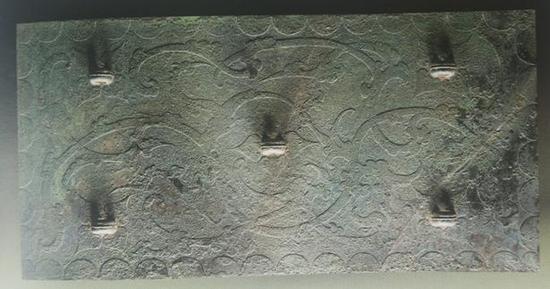
The current argument is that the panels from the Marquis of Haihun’s tomb should be reassembled like the following sketch, as a rectangular sort of bucket-like case with the mirror inside, reflecting out the open side. It would have been placed face-down on the corpse or coffin after the funeral.
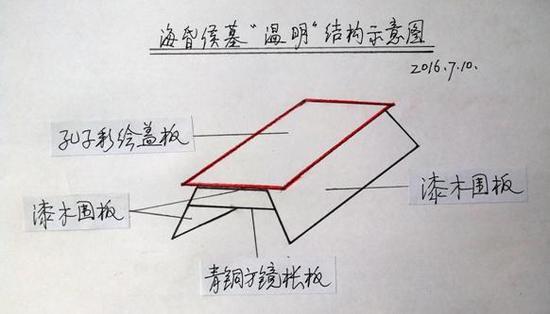
If this is right, we may finally know what this oddly named object looked like.
 Medieval Buddhist of the Day
Leave a comment