
[Bluesky, 11/18/24] Medieval Buddhist of the Day: Lady Hou, the Dowager Princess-Consort of Guangchuan 廣川王太妃侯氏. Lady Hou was the wife, mother, and grandmother of three successive Princes of Guangchuan in the later Northern Wei. She was the daughter of one Hou Shiba 侯石拔, about whom little is recorded. Lady Hou’s dates are unknown, but she must have been old enough to marry and bear children (at least two) before her husband’s death in 480, and she must still have been alive to sponsor two inscriptions (the earlier of which is shown here) in the Guyang Cave at Longmen in 502 and 503. Say, born before 460 and lived to be at least 50?
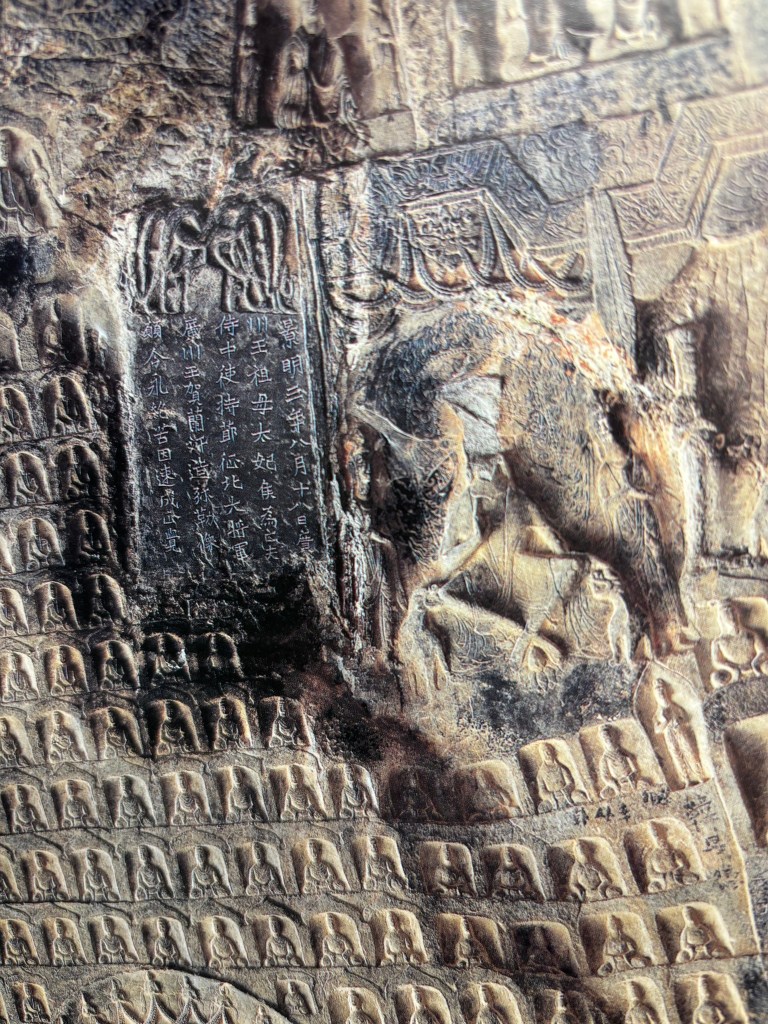
Her husband was an imperial prince, the third son of Emperor Wencheng, named Prince Zhuang of Guangchuan 廣川莊王 in 472 by his nephew, the emperor Gaozu. His titles are military and he sounds like an old-school Xianbei prince, named Tuoba Lüe 拓拔略 but also known as the Helan Khan 賀蘭汗.
When Lady Hou’s husband died in 480, her son, Tuoba Xie 拓拔諧, succeeded to the title as Prince Gang of Guangchuan 廣川剛王 [though I should say that the appellations like Prince Zhuang 莊, “dignified,” and Prince Gang 剛, “unyielding,” seem like they might have been posthumous]. He lived till 495. His son’s name was Yuan Lingzun 元靈遵 – by this time the imperial house had taken the surname Yuan – and he too inherited the position of Prince of Guangchuan. But since his mother had predeceased his father, it was his widowed grandmother who was left to raise him in the imperial court.
The two inscriptions are in honor of her husband and herself, and two others nearby were made in her honor by members of the princely household of her orphaned grandson, probably around the same time. The two in her honor and the one for her husband are all quite conventional and short. It’s her own inscription that gives us a little glimpse into Lady Hou’s story. In it she alludes to the strain put on her, body and mind, by the responsibility of bringing up the third prince, but also to her Buddhist faith, which seems to have been unusually sectarian for her time.
I’m working on her inscription right now, so there will be more. I’m interested in many questions: what did it mean to be a grandmother left with the responsibility for continuing the family line after many deaths? What, after all, was her status in the new capital of Luoyang? What was her relationship to the two household officials who also made inscriptions near hers? What must it have been like to come of age in Pingcheng before the great changes of the 490s, then to come south with the court of her son, and ultimately to be left to manage his legacy?
What about marriage alliances? Lady Hou’s son married a daughter of the Taiyuan Wang lineage, one of the Four Great [Chinese] Clans of the Northern Wei; her grandson married a daughter of the Yuwen clan, descended from the Eastern Xianbei. And did she live long enough to know that her grandson would die without issue, marking the end of the line of the Princes of Guangchuan (though her great-nephew apparently inherited the title for one more generation)? I hope not.
 Medieval Buddhist of the Day
Leave a reply to Lady Hou part 2 – Medieval Buddhist of the Day Cancel reply